
Slide show and discussion with by Rev. Patrick Kennedy, January 2010
summarized by Linda Finigan
Continuing the theme of November’s talk, Patrick began with a brief overview of the qualities of the Mary soul: a receptiveness, an openness to knowing the divine, a connection to Sophia wisdom.
In America, we often don’t think of approaching the divine through “knowing” or through our thinking. In many churches and spiritual movements, the emphasis instead is on feelings on the one hand or fervor and will on the other. “Knowing”, in contrast, often carries the connotation of a painful process, a dry, factual approach lacking life and vitality. “How could the work of the mind result in an inner birth?” one can easily expect to hear.
The key to unlocking our knowledge process is an attitude of soul, exemplified by Mary.
Dry intellectual separation vs the inner vitality of knowing happens through changing how we approach the world. To quote Socrates: Wisdom (Sophia) begins in understanding.
The knowing process must become social, that is, to approach texts and the world as we might approach a person we love and respect: open, reverent, devoid of judgment, with a question. This allows knowledge to become an encounter, inner event that leads to a budding new, higher life.
After the above brief introduction, we studied a series of paintings from the early Middle ages through the late Renaissance that sought to depict that inner experience in their representations of the annunciation: the appearance of the angel Gabriel to the young Mary in her home.
We examined the iconographic elements present in these works. A bird, the Holy Spirit, often seen hovering above Mary’s head, a book held in her hand or on a reading desk, the arrangement and position of the angel’s wings and Mary’s posture and hand gestures, the use of color and the source and angle of light, the position of columns and architectural detail separating the angel from Mary, the quality of the sky and outer landscape were among the recurring motifs.
The final painting in the series, shown above, was a strikingly modern and hauntingly beautiful work painted in 1474 by Antonello da Messina. In this portrait of Mary alone at the moment of the annunciation, the artist concentrates on facial expression and hand gestures to convey an inner awakening to the transformative, world-altering knowledge that Mary has just received.
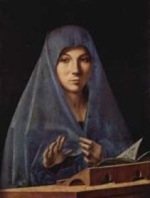 Mary of the Annunciation/ Antonello da Messina /Museo Nazionale, Palermo